

Blog des étudiants et enseignants de la Licence professionnelle 'Qualité, hygiène, santé, sécurité au travail et environnement' - - - - - - - - - - - - - - - - - - - - - - - - - - - - - - - - - - - Bientôt préventrices et préventeurs efficaces, stratèges et bons communicants !

"Learn or leave"
(Apprendre ou à laisser)
Clément FRANCE
The significant lack of people trained in first aid. How can we train more?

INTRODUCTION
 French people, we invite you to join any infrastructure offering training, in order to be trained in first aid.
The next rescuer could be you !
STATISTICS
According to the Ministry of Health and the French Red Cross:
If nothing is done before help arrives, the survival rate is only 3% to 4%. This rises to 10% with cardiac massage and up to 50% with a defibrillator.

 LEGISLATION
According to article R4224-15 of the Labour Code, a company must have first aiders who have undergone SST training in order to be able to provide first aid in the event of accidents. There is no set amount of OHS in the company, but it is recommended to have 10-15%.
By 2022, the government has set a target to train all third year students in the PSC1 module. This objective is planned so that 80% of the population masters first aid techniques.
HOW CAN WE TRAIN MORE ?
There are many training courses offered by different organisations such as :

Today, new applications have been developed to make all first aid recommendations accessible to all people :


FIRST AID PROCEDURES
It is important to know the theory of first aid, but it is not enough. Indeed, it is necessary to practice and train in order to perform our actions in the best conditions.
The following gestures are only an aid. It is strongly advised to go to a training association in order to practice.

In each situation : Protect - Alert (15 / 18 / 112) - Rescue

Thus, we can see that the problem does not come from the establishments offering these training courses but from the Ministry of the Interior which does not impose at any time the learning of first aid techniques from a certain age. By imposing this training, the population will have the duty to be trained in order to perhaps save lives in their turn. It is therefore necessary to add a decree to the regulatory texts of the Ministry of the Interior.
BIBLIOGRAPHY
Ministry of the Interior, statutory instruments, 2017 https://www.interieur.gouv.fr/Le-ministere/Securite-civile/Documentation- technique/Secourisme-et-associations/Les-textes-reglementaires
French Red Cross, "First aid: training for everyone" https://www.croix-rouge.fr/Nos-actions/Urgence-et-secourisme/Chacun-peut-agir/Secourisme- des-formations-pour-tous
French Republic, Public Life, "Safety: train 80% of the population in life-saving gestures," May 2, 2017 https://www.vie-publique.fr/en-bref/19631-securite-former-80-de-la-population-aux-gestes- qui-sauvent
Franceinfo, January 9, 2020, "First aid: only 20% of French people trained in life-saving techniques" https://www.francetvinfo.fr/sante/soigner/premiers-secours-seuls-20-des-francais-formes-aux- gestes-qui-sauvent_3777607.html
The police in France ensure the safety of the population on a daily basis. They protect us and maintain public order. Today the police are harassed on a daily basis, both morally and sexually. Insults, violence, inappropriate words, inappropriate gestures... All these actions have devastating consequences for the police. Some police officers commit suicide because they are harassed on a daily basis. We are going to discover the harassment of some police officers. Why is there so much harassment of the police in French society?
This harassment takes the form first of all of repeated insults. In the neighbourhoods, this is very frequent. Young people often provoke and attack police officers. When police officers are on patrol in sensitive neighbourhoods, they are never welcome. Threats to police officers on the walls, verbal provocations towards police officers, mockery. The first is mostly expressed from a distance, when a patrol passes by or, more directly, when an arrest goes wrong. Some of these acts sometimes seem to have no consequences. But their repetition on a daily basis can seriously affect police officers and have significant repercussions on their physical and psychological health. These insults can go as far as death threats. In some cases, the harassment goes beyond mere verbal abuse.
The police will always be there, today as yesterday and even more so tomorrow. They will continue to hunt down criminals to the detriment of the inhabitants who ask for nothing more than to be able to live in peace and security. Action must therefore be taken to avoid this type of action as much as possible.
Faced with these risks, the DGPN and DGGN have adopted a policy of improving the quality of life at work and preventing psychosocial risks for several years
A mobilisation programme against suicide has been in place since May 2018. It aims to:
Better respond to the emergency (report, take charge and support) through training efforts (e-training module to raise awareness of the detection and management of people in suicidal crisis), through work with support associations, through psychological support measures...
Preventing situations of fragility (understanding, detecting situations and developing a shared culture) by implementing an external implementation of an external telephone helpline staffed by psychologists which operates 24 hours a day, 7 days a week for the benefit of police officers and their families to facilitate access to psychological care
Being a police officer is a hard job to do on a daily basis. The police must be protected.We must therefore support the police force and use these means of prevention to improve the quality of life and health of police officers in the years to come.
Bibliography
Davie.E. (2014, mars). L'exposition aux risques professionnels dans la fonction publique-Une première analyse par métier à partir de l'enquête SUMER 2009-2010. inrs.com
https://www.inrs.fr/media.html?refINRS=TF%20217
Marwan Mohammed, Laurent Mucchielli.(2006, février). La police dans les quartiers populaires : un vrai problème!-Mouvements(no 44), pages 58 à 66. cairn.info
https://www.cairn.info/revue-mouvements-2006-2-page-58.htm
Guide contre le harcèlement sexuel et agissements sexistes au travail:
Prévenir,agir,sanctionner. travail-emploi.gouv.fr
Blog title: Here are magical tricks for teaching
a trainee
the right way to handle
appropriately chemical Occupational hazards in the
campus chemical Lab!!
The tricks
that I will reveal to you in the following pages are very useful as far as Occupational
chemical hazards are concerned. The final purpose of this article is allowing
professionals in campuses to safely handle chemical products in their workplace
in campus labs.
First of all, it is important to keep in mind that your campus Lab is not a common room like your classroom or your kitchen at home... Your campus Lab is a professional space like a workshop where a great deal of chemical products is manipulated, used or stocked in protected shelves or closed cupboards.

By the way, when the sanitary Board makes a request, article R. 4624-4-4 of the Labor Code imposed to any employer to show the safety data Sheet of the chemical products they are using in the Lab or firm. My purpose in tackling this issue in my blog is to enhance a safe practice concerning chemical Occupational hazards Management in campus laboratories. Chemical substance is not systematically dangerous. However, it becomes so, when it is not handled with appropriate manners. When it enters in our body through the skin, or the other ways such as the breathing or inhalation or ingestion, it mixes with the blood and disperses throughout the body. Finally, it becomes harmful for the vital organs. In addition, chemical hazards damage our environnement through pollution.
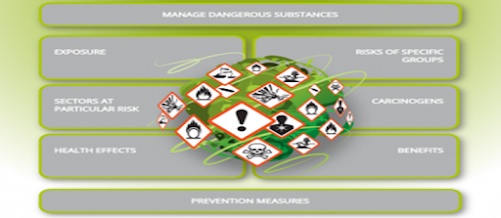
SOURCE : https://osha.europa.eu/en/tools-and-resources/infographics
From that point, there are several reasons why you should respect accurately the Occupational Exposure Limit Value (OELV[1]) in your workplace. However, that limit value is different according to domestic regulations of the European Union member countries. If you want useful information about Occupational Exposure Limit Value in France, visit the following link: http://www.inrs.fr/media.html?refINR=outil65.
Furthermore, there is a wide range of useful information on Occupational limit value of European countries in the following website https://osha.europa.eu/fr/themes/dangerous-substances. As I am absolutely sure you are wondering how to appropriately handle the internship of your trainee as far as chemical hazards are concerned, you could find other useful advices at the following link: www.inrs.fr/publications/bdd/biotox; and in this yearly published guide entitled Guide to Occupational Exposure values, ACGIH. Your can find this useful document by typing its title in a research website such as google.
If you want to know the OELV of any
given chemical substance, you would find that information in the eighth rubric
of the safety data Form. By the way, you might find instructions about
occupational exposure by inhalation in the norm NF EN 689: Occupational
chemical exposures.
I mentioned early that great
quantities of items containing chemical products are stocked in your Lab
Campus. You have to understand that such items should not be stocked like any
common items. When you don’t take particular precautions in putting in place a
safe stockage strategy, your lab could explode making your trainee fly away in
great speed to the skies before the end of the internship.
I am sure that you want to get the magical trick that would help you avoid such mischief., you might absolutely know that all chemical products are not compatible with one another. Therefore, when you keep stocking together conflicting chemical products, there will be explosions and fires in your Lab. So, before putting in place any plan of receiving new delivery of items, you should smartly read and understand rubrics seven, nine and ten of the SDS of all the new items you are receiving. You should also undertake preventive actions limiting damages in case of fire of explosion of your lab. For that purpose, you should put in place airing by aspiration devices so that pure air could be permanently renewed inside your campus Lab.

-
ED 6015 Le stockage des produits chimiques au
laboratoire
-
ED 753 Stockage et transfert des produits
dangereux.
You could easily find and download
these two papers and many others about Occupational safety and Occupational
chemical hazards from the website of the NIRS.
In summary, reading this blog enables
anyone to manage safely hazards related to chemical substances and products.
The main rule to keep in mind is to have a comprehensive chemical Occupational
hazard management. That management starts from putting in place an efficient
airing system, and reliable and appropriate individual protection equipment
according to the activities the workers are executing. The last rule to
remember about is to arrange a compatible storage system.
[1] National Institut of
Research and Safety (NIRS) means Institut National de Recherche et de Sécurité
[1] Occupational Exposure
Limit Value (OELV) means Valeur Limite d’Exposition Professionnelle (VLEP)


